Edible Peace Patch Blogs

Check out our other blogs here: http://peacepatch.org/blogs.htm

Wednesday, February 16, 2011

From garden to table: The Wellness Kitchen


Hi There! I am Sarah Tucker, a graduate student from Ole Miss. This school year I will be working in the garden and in the Wellness Kitchen. Today we went exploring, picking, cooking and tasting! We had so much fun and learned a lot too.


We tasted sweet peas straight out of the garden!

For the 3 & 4 year old Pre-K students we picked, cooked, and ate beets. They loved the bright red color and learning how healthy they will grow when eating them.

For the 4 & 5 year old Pre-K class we cooked our own collard greens.
We picked the collards, washed them off, cut them up, sprinkled balsamic vinegar, olive oil, and garlic on them. Then we cooked them in a frying pan. The Pre-K class loved the collard greens!

With the Kindergarten classes we made kale chips. They were a hit! Kale is rich in Vitamin K, C, & A. It is filled with magnesium which is great for the heart. In addition, it has lots of phytonutrients that help fight diseases like cancer.
How to make Kale Chips:
You need: Kale, olive oil, garlic, a cookie pan, parchment paper, & an oven
Directions:
1. Preheat an oven to 350 degrees F (175 degrees C). Line a non insulated cookie sheet with parchment paper.
2. With a knife or kitchen shears carefully remove the leaves from the thick stems and tear into bite size pieces. Wash and thoroughly dry kale with a salad spinner. Drizzle kale with olive oil and sprinkle with seasoning salt.
3. Bake until the edges brown but are not burnt, 10 to 15 minutes.
Before!
After!


Lakewood has incredible students! I was so proud of how open they were to tasting beets, collard greens, and kale. Next week, I plan on sending the kids home with a recipe to share with their parents.

Take Care,
Sarah

Today was a lovely sunny day in the garden, and the first time some of the kindergardeners ever visited the garden! The kids were so excited to get out into the garden and see all the veggies that have been growing. The kindergardeners knew a surprising amount about the garden already, and one even explained to me the importance of having pollinators around, such as the bees that were loving the broccoli flowers bees on broccoli The part that the kids enjoyed the most was seeing veggies and plants that they are familiar with, such as the corn baby corn. Everyone was also interested in seeing the collard greens, which they all recognized from home meals, as well as the aloe plant, which was recognized by kids who have used aloe lotion to treat various burns.
While teaching the science curriculum, the part that most students were fascinated by was the idea that we need some of the same things that plants need to grow, such as water. Making the connection between the seemingly non-active plants, and their very active selves was a great way to bring home the lesson.
Some lucky classes also got to cook some produce from the garden in the Wellness Kitchen with volunteer Sarah Tucker. They came out to the garden to check out the kale they were going to cook, then went back inside to start the process. Watching the kid's faces light up as Sarah picked some kale and pulled a beet out of the dirt was definitely the highlight of the day.

The Kids Arrive!


Tuesday was my first day working in the garden with the kids and it was absolutely fantastic!
The lesson of the day sought to get each grade level to think like scientists. "What do plants need to grow? Lets go find out!" We looked around at all the plants and decided that plants needed soil, water, and sunshine. Depending on the age group- we really drilled it in Water! Soil! Sunshine! Water! Soil! Sunshine!

"How do plants drink water? They don't have a mouth," one kinder-gardener asked.
"Through their root of course!"
"Well... um.... Miss Shannon.... Whats a root?"
We got into a whole conversation about how for every green thing she saw in the garden, there was a root system that went down into the ground. I used sedge-weeds to show her the root systems. We talked about how the roots were a little like tongues drinking up the water and the plant-food in the soil. She thought that was SO cool.
Another girl, in third grade, was REALLY interested in how plants grow. I spent close to 10 minutes with her discussing the structure, flowering, and fruiting of the papaya tree. She said "So, if you like plants and all that, does that mean you have to like science too? cause I don't like science, but I think I like this garden stuff." We talked about how science was in all things: human bodies, stars, plant cells, soil, fingernails, everything. We talked about how science was really just being curious and having questions. She said "Well, I have lots of questions."
"Then you're a perfect candidate to be a scientist."
"Cooooooool" She responded.
"The cool thing about science," I said "Is not always knowing the right answers, but asking the right questions. You're really good at asking the right kind of questions, I think you've got what it takes to be a scientist."
"Yeah, I've been thinkin' that too."

When we asked what some of the garden rules should be, some of the younger kids had some really great ideas: "don't stand in front of their sunlight", "don't do karate on them", "don't hug them too tight." I didn't think that my work in the garden would get me thinking about government spending and policy so quickly, but wouldn't it be great if we re-directed FCAT money into lowering the student/teacher ratio in the classes? There seemed to be a direct link between number of students and the stress this causes for teachers. I think making the student-teacher ratio a bigger priority would have a much higher impact on students than test-taking. Just an idea though. What do you think?

Monday, February 14, 2011

It's Almost Time!


Today we had our second early-morning weekly meeting at the garden... and what an exciting one it was! Tomorrow is our first day with the students and there is still so much to be done. After a logistics talk from Professor Curtis, my five independent study comrades and I taught the volunteers the lesson plans we came up with for this week (Jamie describes them two posts back). Everyone seemed to catch on very quickly so I am confident that tomorrow will run smoothly.

We began spreading mulch today, but we didn't finish the whole garden. We also planted papaya and continued weeding. Tomorrow we will have to keep up with maintenance while teaching the kids...we will not be bored! I'm a newcomer to the project so I'm especially excited for the kids to come out. This morning I heard two boys on the playground talking about how much they love tomatoes. Two girls walking by on the road sidewalk even stopped to tell me, "I go to this school!" I definitely felt the excitement in the air.

I'll leave you with this awesome picture of our pollinator garden:

Peace!
Erin S


Friday, February 11, 2011

Friday, February 11th, 2011

This morning wasn't exactly the warm sunny weather people come to Florida for, but as for my first experience working in the garden I'd call it a success. Katie S. and I worked the 8:00-10:00 shift this morning.
We began by thinking ahead and setting aside a few things that will be used in the lessons for the students next week. We took a mini adventure to find mulch at the local recycling plant only to find that it was closed, simply meaning its a job for another day. Once back at the school we planted some watermelon seeds and turned our attention to weeding for the rest of our shift.
The garden is starting to look really good with the weeds being pulled and the vibrant colored tops of the boxes encasing various growing vegitables. I'm really looking forward to seeing the kids learn in this beautiful little oasis.
- Chelsea Ehmann

Thursday, February 10, 2011

Rained out but still excited!

Unfortunately I got rained out of the garden this morning, but I think there is still some hope for the later 12:15-2:15 shift to get out there and keep up with maintenance - the sun is trying so hard to come out! If we had the students coming out, rain or shine we would be there to conduct the lesson plans about the garden, but because it is solely a maintenance day, we were unable to do any work.

We may not be in the garden right now, but we are constantly working on lesson plans and things related to the garden! Last night, all of the independent study girls got together to discuss and brainstorm ideas for the lesson plan for next week - our first week with the kids! There are 6 girls, including myself, on the Independent Study team. We were given a basic lesson idea but worked together to make it fun and understandable for the different grade levels of students that we will be teaching throughout the next week. We came up with separate ideas for each grade level but kept the theme of "The Magic of Seeds" at hand. This lesson plan will help Lakewood students understand how a plant grows. What sort of things does a seed need in order to turn into a plant? Where does the seed come from? Come Monday morning we will give the lesson plans and activities out to our INCREDIBLY helpful volunteers, talk about the activities, and get these Lakewood students thinking about seeds!

I took an environmental education (EE) class at Eckerd and I have been a part of many EE programs. While learning how to create a lesson plan and getting ideas, there have been several books that have helped me gain insight into new and fun activities:


I'm excited to start working with the children because I am a novice at gardening and have a feeling I am going to be learning a lot from them. I also enjoy working with kids, especially when it's in a fun and healthy environment - one that they are familiar with and take pride in.

That's all for now!
Jamie
An Independent Study Lady

Wednesday, February 9, 2011

This morning, the sun shone down on the garden giving us some nice rays to bathe in as we worked. Most of the time in the garden today was spent weeding the beds, the three sisters, as well as the pineapples. This sedge is the major weed invader in the garden these days, but we have been diligently removing it piece by piece.

5111177314.gifDSC_0008


Unfortunately, because of the cold, we have lost a few pineapples that we had to dig up this morning. Good thing pineapple tops are quite abundant around here, so I'm sure we won't have any trouble replacing them.

We continued yesterday's bed beautification project by starting to paint the sides of the beds. We are looking forward to getting creative with the designs we will paint on each bed. There's nothing like bright red, blue and yellow to bring some extra cheer to the already cheerful space. Try to imagine these:

DSC_0008

........... but in great new colors! (Photos are on the way!)

Today was also a seed collecting day. We gathered the seeds from old tomatoes left over, and put them in a container to save for later use.

Although we had a great day in the garden, we sure are looking forward to getting the kids out there to help us out!

Tuesday, February 8, 2011

A day in the Garden

Today at the Garden, the temperature was chilly, but with clear skies allowing the piercing Sun's warmth, it made for ideal weather. With perfect working conditions, we swiftly began eliminating those annoying weeds from in and around our Garden. After about 30 minutes, feeling warm and cozy, we started adding color to our wonderful Garden. Blue, Red, Yellow and even black painting covered our Garden Boxes top edge. These colors gave the dull boxes a little bit of life, and authenticity.
Lastly, with the majority of our time spent eliminating weeds from the Garden, we successfully began to plow another 2 feet uprooted land. Leaving solid dirt which will then be covered by mulch for more control over weeds. This enhances our native plants survivor from succession and competition including the good ol' lands keepers.


This box I personally painted


While working in the Garden today, I was surprised to see that even maintaining a Garden would be amusing and social. While we individually worked, we listened to top 40 music and held frequent conversations, getting to know one another and our interests. Occasionally some laughs were shared and friendships were made, which in my book marks as a successful day. I'm excited to see the progression and represent that creativity goes a long way.

Student Volunteer,
Camilo

And we're off!

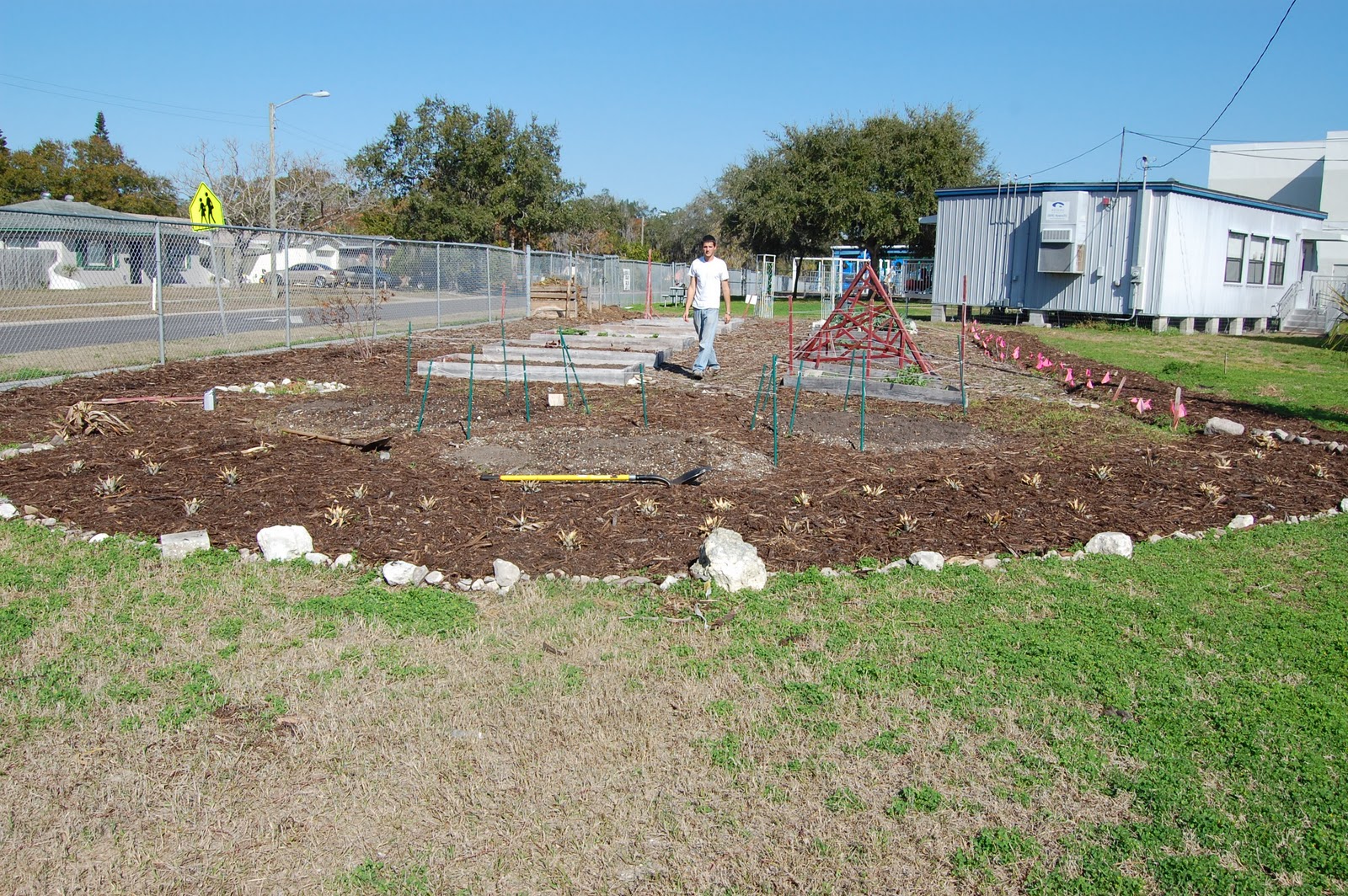
These are photos from the end of Winter Term (January). Somewhere, there is a camera with pictures from yesterday. When I find it, I will post those as well. If you saw them, you would see this beautiful garden filled with people. We have more than twenty participant garden instructors in the Peace Patch this spring. All of them gathered with me for our first weekly project meeting of the year yesterday morning. For two years, I have met with Eckerd students weekly at Eckerd College to discuss the garden, go over lesson plans, and monitor garden progress. This year we hold these meetings at the garden. Every Monday. 7:45 a.m. And so, there we were, sitting around in the heavy fog and light mist of winter Florida, learning about the new native plants we have put at the edge of the Patch, looking at the depth of sedge roots, examining sprouts, sampling parsley, sipping warm coffee, and planning the work ahead.

Six Eckerd College students will be taking the curriculum we have been building over the past two years and adjusting the activities and the lessons to become grade appropriate. (In the past, we have aimed for the middle and found it too much for the youngsters and too little for the older kids; they change FAST at this age.) Some seventeen to twenty (we're still sorting things out) Eckerd volunteers are also staffing the multiple shifts so that all of the classes from K-4 at Lakewood Elementary will be able to visit the garden once a week until May. We have two Academy of Senior Professionals volunteers joining us as well, Julie and Elria, and a student from USF. We have a project intern for the spring, Sarah, a graduate student from Ole Miss, who is helping us add nutritional and health-oriented elements to the garden work and to the curriculum.

All of them were there in those photos. Curious, excited to be underway. Some of them hiding from the camera. Other hamming it up. Everyone making my day that much brighter.

The starters seen above have all sprouted and I also have pictures of the tomatoes sprouted there (from our own seeds from our plants from last year) being transferred to the bed where they will grow this semester. Students getting their hands dirty preparing the food plants for a three month nurturing into fruit. The potted plants you see below are the natives we've added, and they too are already in the ground in the pictures on that camera which I will find before too long. Here they are!


Kip Curtis
Peace Patch Project Director


Tuesday, January 18, 2011

Sunshine and Rain

We are getting a big dose of exactly what we needed in the garden over our three day weekend. With a steady, soaking rain and a warm and sunny afternoon, the Peace Patch is starting to sprout our little seedling friends all over the place. We've got little green cucumbers starting and our sunflowers are beginning to wiggle their way through the soil as well! It feels extremely rewarding to know that our hard work is going to turn out such a plentiful garden.

This past week we have continued with our many jobs and have mulched almost the entire garden over which means we just need to go over the old mulch to freshen it up a bit and we are done! Today in the garden we planted every last seed we have. The beds will soon be overflowing with broccoli, herbs, tomatoes, sweet peas, and carrots as well as several types of wildflowers. The part I am most excited about it our soon to be native plant stretch along the side of the garden. Thanks to our friend Michael at Twigs and Leaves, we will have about 65 feet of Florida native plants making a nice fence line to the left side of the garden. It will include all sorts of hardy Florida plants that all have edible components such as the Simpson Stopper whose fleshy fruit tastes like guava and the Jamaican Caper with its bright red pea pod. The goal in picking these plants was not only to make sure they were Florida natives, but that they appealed to several of the senses. Not only are the plants edible, but they are fragrant and brightly colored, most with flowers and berry-like fruits. Plants like these not only attract birds, pollinators, and other good critters for the garden, but also are exciting for the Lakewood Students! The plants come in Friday so by next week we will have a pretty diverse stretch of additions to the garden.

Outside of the garden there is still much to be done as well. At the moment we are all working on collecting photos to create a display board to draw more volunteers in. We are hoping to have a full schedule of classes for the entire semester so we are keeping our fingers crossed that more people wonder our way!


Tuesday, January 11, 2011

Patchin' Up the Peace Patch

So over the past week we have continued to revive our garden to its fullest potential in hopes of expanding it in the near future. We have mulched, planted, and supplemented our sandy soil. One factor I am really excited about it the line of sunflower seeds we planted along the sides of the garden. Our goal is to surround the garden with 12ft gorgeous sunflowers! Also, we took a little field trip to the Saturday Morning Market in downtown St. Petersburg for some free pineapple tops from one of the stands. Pineapples can regenerate from one part of the fruit so we buried two rows along the backside of the garden in hopes of yielding some delicious fruit. We've also constructed a trellis for our climbing cucumbers that looks something like modern art. For all of our climbing plants, we will be building these wooden trellises. It really adds something to the garden.

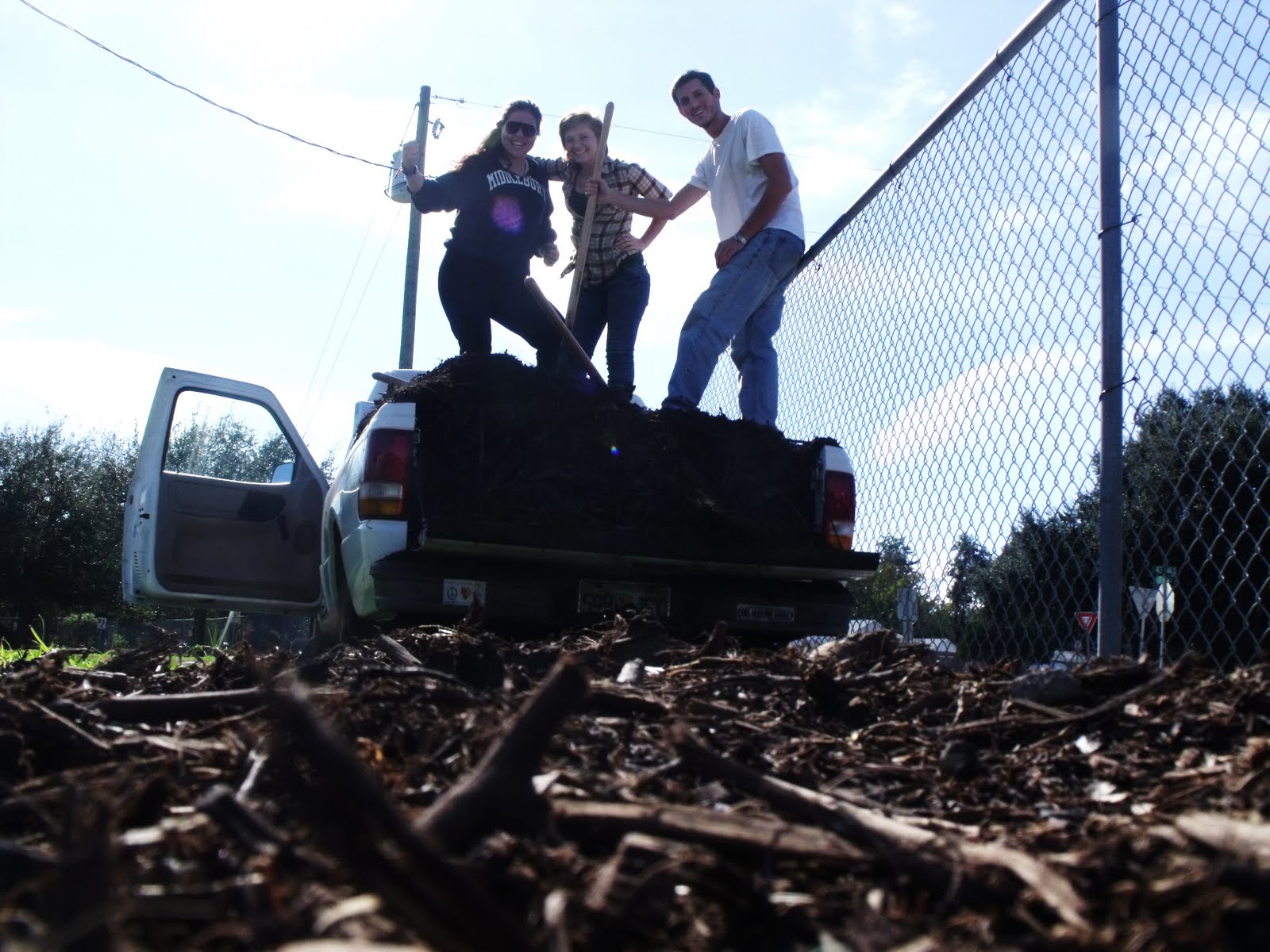
This week we are focusing on prepping the soil for planting more veggies such as collards, beets, turnips, broccoli, sweet potatoes, etc. We have also began little starters for okra, bell peppers, spicy peppers, and eggplant. Thanks to Saddle Up Riding Club, today the group got a truck load of free horse manure to turn into the soil. The other focus of this week is making it beautiful and functional with more mulch! We retrieved several loads of mulch from the local recycling center and plan on covering the entire expanse of the garden to block out unnecessary weeds and sedge, as well as show off how pretty our garden is.

This past week we have also welcomed a 3rd intern to the group, Ethan, who will be working along side Sydney and I everyday in the garden. The three of us are really looking forward to this upcoming semester for many reasons. For one, the garden will be at its peak. We have big plans such as more beds, different vegetables, a possible seating area in the garden itself, and much more! We are also going to be giving more power and responsibility to the students. This upcoming semester, the Peace Patch will be lead by four Independent Study students from Eckerd under the guidance of Prof. Kip Curtis. The important thing to remember is that this project is not possible without the dedication of our volunteers! We need close to 24 volunteers, weather returning or new to the project, to be willing to devote just a few hours a week to making this project the success we all know it can be!

Tuesday, January 4, 2011

Welcome Back!

As the new year rolls in, it's time for Sydney and I to get back out there in the Peace Patch. Under the guide of Prof. Curtis, Sydney and I will be doing a 30 hour per week internship for the rest of the month. This will include getting the garden up and running after that early freeze, getting organized, planning ahead, and much more!


Today, walking in the garden was a little daunting, but that didn't stop us from getting right down to business. First stop: The Shed. As they say, "A cluttered desk is a sign of a cluttered mind" and who can work with that? So we emptied it all out, recycled the trash that we could, found tons of exciting pots, books, lesson plans, etc. that we never knew we had, organized the shelves, and took inventory of the whole lot. After this tedious task, our major concern was to sort out the seeds to see what we needed to buy. We saved what we could and got ride of what was expired.


Out in the garden we pulled the dead plants and fed them to the compost monster, slavged seeds from the old vegatables, turned the beds, laid down carboard, transplanted plants such as Dill which seems to sprout up everywhere, removed crowded plants, and gave the garden a pretty swell makeover.


There is still tons to do, but Sydney and I are formulating a game plan to make this garden all we know it can be!

Wednesday, December 8, 2010

Ta Ta For Now.


Today was our final Wednesday class and my last lesson at the garden today. Walking out into the garden today I stopped to admire all the hard work this year. The tomatoes are almost ripe for harvesting, we have already harvested some eggplant and green peppers, the beets look ready for eating, and the black eyed peas are nearly poking their heads out. It was a great site.
The first class came out a little apprehensive because of the cold, but when we started talking about their favorite parts of the garden the fire behind their eyes lit up. I could not get Jevare to stop talking about watermelon or butterflies. He proceeded to tell me the stages and then started drawing them for me. Destiny wanted to make sure that all of her favorite vegetables were included in her picture, while Miles drew the stages of a plant. Each student had
pulled different subjects we had covered throughout the semester. They were all extremely eager to explain them to us as well. Words that were a struggle for some on their first days at the garden now seemed easier for them to recall. Most of the students know how to make a compost and why it is great for the environment. Almost all of the students can tell me each stage of a butterfly without a struggle. It was pretty awesome.
When the class left we exchanged hugs and good luck for the upcoming exams we all were anticipating. I can't help but feel overwhelming appreciation for this experience. I really look forward to seeing every single student next year.

Monday, December 6, 2010

REVIEW


It has been quite a semester! It was a very blustery, frigid morning as we arrived to the garden this morning! Regardless, our last Monday with the kids were still so excited to be there! I find that it's a nice break from their school life and you can even see the appreciation on their faces. As finals quickly approach, it is refreshing to see a wide, gap-toothed smile and hear laughter!


Today we reviewed our semester's lessons and the intellectual turnout was no less than satisfactory, if not above expectation. We began by handing each kid a blank sheet of paper and their choice of crayon color. We started with the basics, asking what all goes into a garden and with great success, the kid's knowledge flourished as they began to scream that the sun, soil, and water are three basics that help our garden grow! Their drawings began to develop and our questions proceeded. We reviewed the water cycle, metamorphic cycle of a butterfly, and compost. The drawings were really interesting to see. They ranged from the very general cloud with rain to a very specific butterfly cycle with labels and numbers to show the order of the cycle. I think their favorite is the metamorphic cycle of the butterfly because of the game we played with them earlier in the semester! It really stuck and it showed as they shouted the answers! Another favorite was the compost! Though it is a nasty topic, they really enjoy the fact that horse manure helps!
I think our hands-on activities throughout the semester have really made a difference! I could tell just by our minor questions that the kids really enjoyed learning about the garden and what goes into the garden! Our last Monday ended with an epic game of bees and pollinators! To our surprise, the kids were fast! As our blood began pumping, the game got more fun leaving our time with the kids special!


Friday, December 3, 2010

Brrrrrr!!!

It's cold! And being a native New Yorker does not give you any tougher skin than the Floridians. Even with the cold, there is nothing to fear for our plants right now. I had several teachers asking if the cold was harming them, but as long as we stay above freezing temperatures, our little guys should thrive. Should the time come that the cold is unbearable, I've been stocking up on cotton sheets from Salvation Army to cover up the green guys at a moments notice.


Despite the cold wind, the sun made it all much more bearable. Due to my right-hand-woman being sick today, I took on the garden and the students by myself. The kids were really well behaved and right on board with me. We followed through with our water cycle lesson and also had time to do part of the butterfly lesson because our Friday classes had missed that lesson. They were all smiles today, eager to tell me all about their Thanksgiving feasts as well. We discussed what they ate with their families that can come from the garden and I loved to hear that sweet potatoes, green beans, and squash were some of their favorite foods!


Today I was able to continue mulching throughout the garden (I swear that will never end), weed, clean up the shed, and organize some things. A few weeks ago I had some pre-schoolers venture out into the garden to plant some squash and pumpkin seedlings. Today they came back to check-up on their "babies" and they are doing great!

I love walking into the school and having some of my students wave at me, or say hi, or even ask "whats up in the garden today?". The intrigue and excitement on their faces makes it so worth it. They love to learn and I love to teach!

Thursday, December 2, 2010

The Rain Game

Today was arguably the coldest day of the semester thus far. At a crisp 55 degrees, we continued the water cycle game today: the kids all gathered together close to represent water molecules in the ocean. One of us represented the sun and stood about 30 feet from the group while the rest of us came by and tapped the kids (the water droplets) on the head signaling them to run to the sun (evaporation). Once the kids have gathered in the sky as clouds (condensation) we tap them on the head again and they run back towards "the ocean" symbolizing rain (precipitation). We tried our best to teach the kids the pronunciation of the words evaporation, condensation, and precipitation- it was really cute listening to them try and sound out each syllable.


We spend the rest of the lesson going through the garden showing them the growing plants. They were very knowledgeable about which vegetables grow above ground and which grow below ground and which bugs were best for the health of garden. Their minds are like little sponges, they enjoy absorbing as much information as possible.


Wednesday, December 1, 2010

Some housekeeping...

Since the lesson was written about in depth on Monday, I'd like to take a minute and talk about two "housekeeping" things. First off, the harvest festival. Last year I was on the committee that planned the harvest festival, and boy oh boy, it's much easier splitting up the work between four people. Yet, if we get a good RSVP from the Lakewood parents, I'll be extremely excited to be able to pull something like this together. Last year was so much fun, and ifwe can't do something for the parents and kids, I at least want to do something for the kids in the garden. So, at this point, with enough RSVPs we'll be working in conjunction with the campus garden to bring a wonderful harvest festival. There will be dishes from each of the Eckerd students, along with a main course. Hopefully the campus garden pulls through and we have a successful harvest festival. An added benefit of having the harvest festival on campus is to give the Lakewood students an idea of what college is. Hopefully, working closely with them over this semester and in the past, they will want to go to college, want to seek out higher education. I'd be interested to see if any studies have been conducted to see if there is a correlation.

Secondly, the grubs are back. Think about the Lion King, and what Timon and Pumba eat: nice, fat, juicy, grubs. The first time I saw a grub, I immediately knew what it was, just because it looked like something Timon and Pumba would eat. I've done sporadic research on them, and it seems they like to inhabit areas were sedge is growing. Now the battle against sedge is always upon us in the garden, so I've been looking into some alternative treatments. It seems our best bet is to buy nematodes. Yet, after researching nematodes, I've come to learn there are good nematodes and bad nematodes for a garden. The good ones will attack the bugs, but the bad ones will attack the plants (exactly what the grubs are doing, so that would be double duty)! More research will be done, and I will get to the bottom of the proverbial nematode barrel. Until next time.