Edible Peace Patch Blogs

Check out our other blogs here: http://peacepatch.org/blogs.htm

Tuesday, February 26, 2013

Necessity of Nourishment


Sally, Alix, and I arrived at Lakewood Elementary this morning, and the administration office looked a bit surprised to see us, given that it's dismally grey outside and under the warning of a tornado watch. "We still wanted to come," I said. If any kids had happened to come out and we hadn't of shown up, they would have lost interest in the garden in the long term. We walked through the hallways, giving high-fives to familiar faces and responding to their excitement, and head out to the garden.

 This part always intrigues me because, being a garden, you never know what to expect walking in each day. New seeds are planted, some flowers may have withered, or fruits may be ready to pick. Today proved no different, showing me how much everything has grown so far in the few weeks we've been working here. The picture to the right shows how the Lakewood Edible Peace Patch is coming along on the morning of February 26th, 2013. 


We began to prepare for the classes, while in the back of our heads we keep wondering how this weather is going to effect the day. We start to hear pitter patters on the tin roof of the shed and are about to pack up and call it a raincheck when out proudly marches our first class of the day, the first graders. So we begin our planned lesson, splitting the class into three small groups (the same ones they had been split into last week) and try to remember names. I hold out my hand that is full of three different types of seeds: squash, beans, and corn. 


I first ask the kids if they knew what I had in my hand, and they all responded, saying they were in fact seeds, and that "These are what we need to put in the ground to make things grow!" "Exactly," I tell them. "Do you know what kinds of seeds these are?" The responses I got ranged from blueberries, to lemons, to different assortments of flowers. I asked how they knew the differences between the different kinds of seeds, and they named all of the correct answers, including color, shape, and size. We eventually worked together and specified which seed is which, followed by my question of where the seeds were located in the garden.

My group wasn't exactly sure about the beans and squash, but could remember the corn from the week before (pictured left). I think they remembered the uniquely circular shape of the bed that the corn is planted in. I told my group how not all corn was the standard yellow that they're used to, because the seeds we had were a deep red/violet (which is why they were mistaken for blueberries.) Also, the kids were excited to see growth in the corn plants from the week before, and wanted to know when they would be ready to eat. The rain started to come down a little, and my team didn't miss an opportunity to distract themselves, quickly pointing it out. "It's good!" I said. "We need some rain to help the garden grow; it's necessary nourishment." We ended up losing track of time from all of the interest in the seeds that we didn't get to plant the seeds together, but Sally, Alix, and I did put together a small pot of the planted seeds to give them when we see them next. Before they left though, I was able to get a picture of team blue proudly showing off the seeds they learned about today.


Unfortunately, we were rained out of the next two classes, but I'm glad we had to chance to meet with the first one again. It was great reconnecting with the kids over such a great project.

Until next time, Team Blue leader,
Andy


Monday, February 25, 2013

Let it grow!


Today was a calm, humid and sunless day at the Lakewood Garden.  Sadly, our Kindergarten class that was scheduled for today did not make it, but we still found things to do.  First, we watered all the beds and did some weeding while snacking on some green beans.  
Colby and I watering


Breege had the idea that we should plant some sunflowers in the empty beds and with Robin’s approval we began to plant them. As exciting as it is to see a plant when it reaches maximum growth, placing the seed in the soil is just as arousing.  After seeing the sunflowers at Sanderline, I am enthusiastic to watch those grow just as big!


Breege planting a sunflower seed


We were all very excited to see the start of a pineapple.  With my class last week the kids kept asking if they could pull  the crown out to get the pineapple.  I explained that that is not where the pineapple is and that it will come out of the center.  They did not get it and kept asking.  It was cute but now they will be able to watch how pineapples actually grow!


Pineapple on the way!


I was at Lakewood last Thursday and was pleasantly surprised to see how much everything had grown in just those 4 short days.  That is the great thing about gardening. Seeing something go from a minuscule seed to a green sprout and eventually a full-grown vegetable/fruit bearing plant is truly intoxicating.  Witnessing the whole process it truly humbling and the reward is worth the wait.  Similarly to those who workout and want results the next day, gardening is the same way.  Things take time to develop and like most things in life patience is essential. Secondary to teaching children, I am looking forward to watching the garden grow. 


The lovely garden


You can’t reap what you don’t sow
Plant a seed inside the earth
Just one way to know it’s worth
Let’s celebrate the world’s rebirth
We say let it grow
~"Let it grow" from The Lorax (2012)

By Katy


Tuesday, February 19, 2013

A Fresh Start


Welcome to our garden! Lakewood Elementary Spring 2013

Today was the first day of teaching lessons at Lakewood Elementary for the spring semester and excitement was in the air.   The excitement was shared between student and mentor as everyone came together and exchanged happy hellos.  We had three different classes of all different ages visit the garden today.  The kids lined up on the sidewalk as we counted them off by threes.  As soon as we divided into smaller groups,  the fun began.  Many of the children had visited the garden the fall before and were eager to be back.  Simple conversations turned into giggles as we talked about garden related subjects.  We all exchanged our opinions on favorite vegetables and fruits.  I was amazed to see how many of the kids actually enjoyed vegetables.  When I thought back to when I was a kid I never remembered feeling that way.  Perhaps the fact that these kids see their vegetables growing here makes them more interested in eating them.  Regardless,  it made me smile that these children loved their greens!  Next, the kids ate some fresh green beans from the garden that we picked for them.  Eating these little beans got them the most thrilled.  Walking around the garden we gently felt the different leaves and squatted to see the new seeds that had been planted.  Twenty-five minute visits with the kids felt like no time at all.


Andy gets a big hug from a student
Our garden beds for this spring

In between classes we watered the herb garden and planted a fresh dill plant.  We also planted corn in the Three Sisters garden.  How much life is already appearing in the garden is amazing.  To see it flourish before my eyes in this short amount of time makes me look forward to the semester.  I believe many lessons are ready to be learned these next few months! I am pumped to get to know these kids and learn some lessons from them as well.

Little beans beginning to sprout

Beautiful freshly planted corn! 


:)
-Sally


Tuesday, December 4, 2012

A Garden Goodbye

Julia harvesting some plants from our beautiful, green garden at Lakewood Elementary School!

 
Some of our second graders having a good time answering the evaluation questions for us.

Some of the delicious vegetables that we harvested from the garden today to share with our classes and the secretaries at the front desk!

I must admit today was somewhat of a sad day as it was our last day working in the garden with our classes for this semester.. However, it went fantastic! We planned out our lesson and looked around the garden until our first class of Kindergarteners came out. Then, we went over a review of the numerous lesson plans that we taught over fall semester to evaluate how much the kids had absorbed. Our first class, considering their young age, did very well which made me very proud. After the evaluation we split up into groups and went to check on the progress of the carrots in the garden, which are coming along nicely! Before our second class (the second graders) came outside we took time to harvest some of the ripe vegetables. Once we were all set up, our class came out and we evaluated them as well. I was extremely impressed with how much information the kids had retained. It is clear that they have come a long way from when they first started visiting the garden with us. To reward the kids for their hard work and cooperation we shared some of the yummy vegetables with them and finally said our goodbyes. 


Friday, November 30, 2012

Bountiful Plants!


Today at the Lakewood garden, Lillian and I went for our after noon shift. Lillian watered the plants while I planted some more pineapples.

Here's a picture of the pineapples I've planted over the past year at Lakewood; some of them are getting pretty big.

The carrots are certainly getting bigger, but it appears they need a little more time to grow.

 This is a cluster of ripe yellow beans, ripe and ready for harvest. We were snacking of some of these tasty, slightly sweet treats.

This is a close up of one cluster of tomatillos. They should be ready for harvest soon. They may closely resemble an oversized cocoon, but there’s actually fruit inside these.

Look at that squash! It’s growing so wildly it’s practically touching the pineapple patch/butterfly garden.

The biggest and perhaps the healthiest plant in the garden: the Papaya tree. Planted where the compost used to be, it rocked up to be over 7 feet tall!

Friday, November 16, 2012

The Cold Winter Wind Doesn't Stop Our Shine

lovely Fall weather

Today we did the scientific method with both kindergartners and second graders. Before we headed out to the garden to do our experiments, we first asked the students "what do you ever wonder about while in the garden?" As you can see, many of them had a thought for us.

Kindergarten

Lilian and Noah helping the kindergartners write down their thoughts 

They had plenty of questions, such as, why do we NEED to have water for the plants to live? or how are flowers made? Their first steps to becoming great scientists!

 The kindergartners have never done the scientific method before so when it came down to business I decided to measure whatever their favorite flower, plant, or leaf might be. While doing so, they seemed to become more interested in whatever bug or flower they admired for its aesthetics  "The Okra flower is so pretty." one student told me. How could I disagree? Of course I just went with it, and implemented it into our experiment. I measured the Okra flower and whatever else they thought was pretty or interesting (except bugs).

Before questioning 


After questioning


Now came the second graders. Our group decided to make the wonder-wall unique this time.


The Scientific method with the second graders was very successful. Before I measured anything, I first asked the students what their predictions might be. "How wide do you think this leaf is?" I would ask, "2 inches," one student said, "no, I think it is 3 inches." another replied back. The leaf ended up being 2 inches, and the student that answered it right felt like a pure genius. Great job I said, then I encouraged the student to measure a different leaf by them self. I also encouraged the other students to measure a leaf, steam or flower by them self. The kids loved measuring and they loved making predictions. They performed like natural born scientists out here in the garden.

Second Grade

My group of students wanted to take a picture. I told them if they performed well I would. Here's the great group of scientists.

-Peace-
Camilo

Tuesday, November 13, 2012

Questions and Bugs

Our beautiful garden;
look how green it is!

The lesson for our kids this week concerned the Scientific Method. It was one of the funnest lessons I've been able to do with students.

In my first shift, my kids are kindergartners. They had never been introduced to the scientific method. This was something completely new to them. At least with the other lessons, their teacher had introduced the concepts in their classroom and our lesson in the garden was just to reinforce their classroom learning with application. But here we were, introducing this big, important concept for the first time.

"It's alright, we're scientists!" Diane assured the kids when they and their teacher both expressed concern that the kids had never learned about the scientific method. Diane and I explained to the children that, basically, the scientific method starts with a question. After the question, we observe. I told them that in the garden, we could observe in many ways. Their teacher is a big fan of observing with as many senses as possible, and the kids used their eyes, fingers, and nose to make observations in the garden. I let them touch the papaya fruits growing on the tree. The fruits were milking and the kids had a grand time smelling the sticky, stinky substance.

I directed them to the sunflower beds. "Hey, how tall are those sunflower plants? Let's go find out!" I had a yard stick and held the plant upright next to the measuring stick and asked the kids if they could read to me how tall the plant is. They loved that.

I wrote down the observations and asked them, "Now that we have some observations, how tall do you think these plants will get in the next two weeks?" At this, the kindergartners seemed to lose interest, and dragged me to look at plants with their teacher. I did get predictions for 20 and 50 centimeters of growth, so I jotted that down before following the kids through the garden and throwing questions back and forth with them.

~

My second shift, I focused on maintaining the garden. Our kids for this shift, also kindergartners, didn't come out, so while we had prepared for them, we didn't get to do this fun lesson with the children.

Marissa, Michelle, Laura, and I still enjoyed ourselves.

It was a hot day. Really hot. Even so, we did our work pretty well, if I say so myself. We weeded and watered, managing not to spray each other with the water to cool down, I may add. We built up the starter dirt pile.

And, in the vein of our prepared lesson, we made our own observations. They mostly had to do with insects.

Assassin bugs were out in force today. I showed them to my friends (I can't call them coworkers).
There were plenty of juveniles of different stages. I've not seen any really mature ones in this garden. That, or they make 'em different down here in Florida (I'm originally from Ohio).

Assassin bug

There were plenty of them; some of them were small and completely red or orange, but most were at the stage of development the one above is exhibiting. I tried to move some over to the okra, which had been getting eaten up. The previous shift, Diane and I had remarked at how many aphids there were on the Okra. 

Eaten up okra leaf

Luckily, we saw plenty of lady bugs on all the plants, so hopefully the aphids will soon be under control.

Ladybug on the okra

Other insects we saw included butterflies, caterpillars, and a bee about 1.5 inches in length! It was the perfect day for bug-watching.

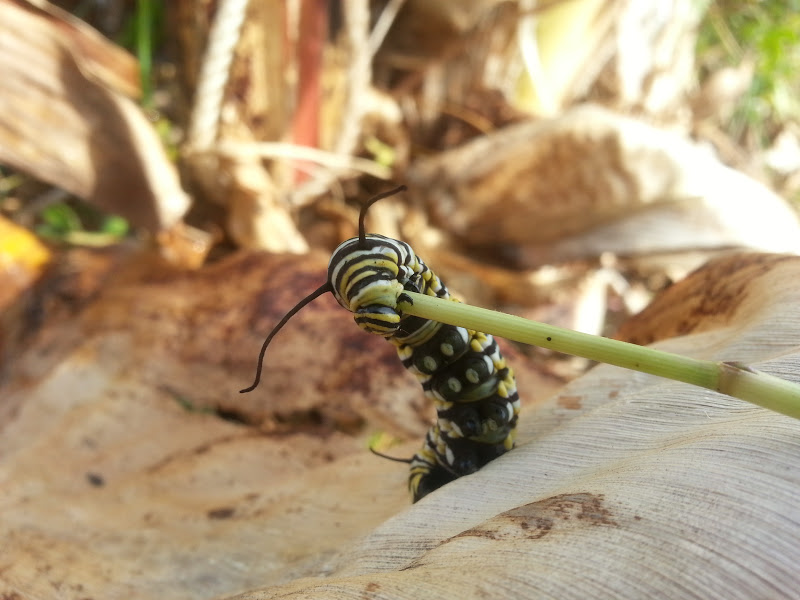
We believe this is a swallowtail caterpillar.

A pollinating butterfly

As a last note, we harvested some beautiful gourds and radishes.

Delicious looking radishes

-Mara


Saturday, November 10, 2012

The Single Greatest Lesson The Garden Teaches


The single greatest lesson the garden teaches is that our relationship to the planet need not be zero-sum, and that as long as the sun still shines and people still can plan and plant, think and do, we can, if we bother to try, find ways to provide for ourselves without diminishing the world. 
-Michael Pollan


Yesterday, as with every Friday, I was driving from our garden at Sanderlin and heading to Lakewood for my mid-day shift there. Though maybe I should stop referring to it as a 'shift', as the word 'shift' seems more appropriate to describe the monotonous clocking into some dreadful job (with stereotypical office punch clock), rather than the excitement I feel walking into prepare for the garden lesson. We started with a bit of maintenance and planting some native plats before getting the lesson ready for our classes. I spent some time watching the bees and pollinating wasps and metallic flies buzzing around the red okra plants and tomatillo shrubs, both of which are quite large and producing lots of flowers and fruit. We had our class of kindergardeners reviewing the water cycle and spent a good amount of time teaching them to water with the watering can, which a few of the kids had said they had never done before. We had a bit of a frenzy going after the watering cans at first, but the kids eventually got the rhythm and were quite good at sharing the watering. After our kindergardeners, we had our second grade class focus on bugs, as they had missed that lesson and really wanted to still do that lesson. So we taught them the categories of beneficial bugs in our garden: Predators, Pollinators, and Decomposers. And we then took them into the garden to find bugs in each of these categories. My group found some ladybugs and orange assassin bugs which are predators of pests like aphids, spotted bees and wasps pollenating the flowers of the tomatillos, and turned of a log to see our favorite decomposer the rolly polly. We also saw some pests, like the melon-worm, which were eating our plants. I talked to the kids a bit about what they thought about us having to kill the melon-worms to keep our plants alive, as I know I am still struggling between the necessity to kill them and my desire to not kill even little green caterpillars. The kids did not seem to share much of my concern for the melon-worms, but at least humored my philosophical conundrum for a bit before running off to go see a giant spider some others had found near the compost. Just before they had to leave, I found a cockroach—another less-loved decomposer— and the kids were both horrified and fascinated that I was letting it crawl on my hand. Then one girl came to me and asked to hold it, and then mischievously ran it to her teacher who was less than enthused about having the cockroach brought to her. Seeing the kids get so excited and connecting to all the parts and processes of the garden, and seeing them learn to cooperate with one another really exemplifies to me why this project is so incredible. These kids really make this time not a 'shift,' but a pleasure and lesson for me as well.

—Noah Schlager

Thursday, November 8, 2012

Harvest Time

Unfortunatly I didnt bring my camera today, so I didnt take any pics, so I hope my words will be enough.
Today was cold, very cold, but the sun was shinning bright and me and Lorel were ready to work. Our first class didnt show up, so we devided to turn the compost until the next class come.
They arrived and we divided them in two groups, one to weed and the other to water and while doing the activities we brought up the various lessons we had taught.
Lorel harvested some okras, peppers and radishs with them and they all had a blast eating it and got a bit greedy to harvest more, so they all went crazy all over the garden looking for something to pick.
"Can I pick this..?" "This looks ready.." "I didnt pick anything..", oh kids. The teacher helped us get them organized again and than thanked us for the lesson saying everyone had a really good time.
We did too.


Monday, November 5, 2012

Childhood Innocense


Today was a beautiful day at the Edible Peace Patch at Lakewood Elementary School. Mara, Laura, Michelle and I have been coming to Lakewood every Monday afternoon since September. We have not had the same class of students consecutively due to the switching of schedules, but today we had the same group of kindergartens as last week. We were all excited to work with the students again and continue getting to know them individually. Last week we introduced ourselves, went over the rules of the garden, walked the students around the garden because this was their first time coming out to the Edible Peace Patch, and went over the water cycle. The children were all very enthusiastic, along with their teacher. They were very excited to learn about the garden and they were impressed with the eggplant and other fruits and vegetables growing in the garden. This week the students only came out for about five minutes. Since we did not have much time with them, we cut open a papaya and showed them what was inside. They took turns touching and holding the papaya. We also showed them okra and they each had a taste of it. Lastly, we cut a melon open and they loved sticking their hands in it to take the seeds out. We also had three unexpected first graders come out to the garden for twenty-five minutes. They were rewarded with twenty-five minutes in the garden due to good behavior. They helped us water the plants and pick weeds. They too were very happy to be apart of the garden. We also showed them the vegetables and let them pick an eggplant to take back to their class. Watching the students get so excited about the garden amazes me. The simple task of holding a vegetable makes them so enthusiastic and feels like they are a part of the Edible Peace Patch.


                                        The eggplant we picked with the students. Yumm!

                                    Students holding the papaya. They were so excited to hold it!

Green pepper looks like its ready to be harvested!

                                                        An interesting insect we found.

It blended itself in with the leaf.


Tuesday, October 30, 2012

Sunny Thursday Morning

Thursday was a pretty day with lots of wind, which is the perfect weather for gardening. Lorel and I opened the shed and got the materials for the first class. We reviewed the rules with the kids and the last lesson, I love how all of them are so excited to participate and are always with their little hands up, it makes me happy, since it shows how much they want to be involved with it. After that, we explained the precepitation process and walked with them though the garden, showing all of our growing veggies (something that also makes me really happy).

We had a break until the other class come, so we decided to weed. Weeding, weeding, weeding, isnt it kind of a relaxing process?

Finally, the second class joined us, the teacher of this one is really nice and she enjoys the garden as much as the kids, so she is always helping us and encoraging the kids to participate. As we walked the kids through the garden, she suggested that the kids could make a scarecrow for it, since they were learning about it in school. I love the idea and I think it is really good when we can relate things they are learning in school with what they are learning in the garden.


I mean, one of the best learning experiences for me is when I can relate the things I learn with my life, it is the best way for a subject to stick with someone.
Finally, we waited for our third class, that never showed up, so we continued weeding and then left, with the promise of a next week full of kids and involvement.