Edible Peace Patch Blogs

Check out our other blogs here: http://peacepatch.org/blogs.htm

Thursday, February 18, 2010

Cultivating


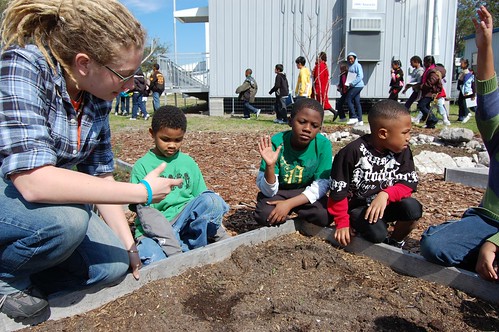
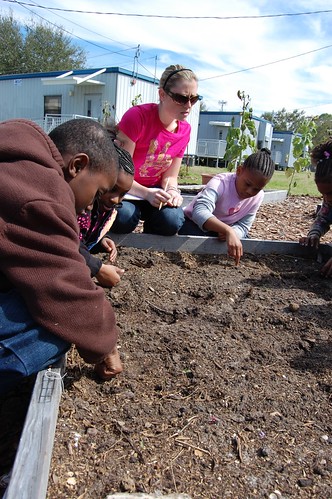
There's a startling beauty to a garden filled with children and young adults. For two weeks now we have been beginning our work. Eckerd students in pairs and triplets and quartets have been planting seeds, turning compost, pulling weeds, and watching the first hints of our future crop begin to show itself through the surface of the soil with a whole cross section of Lakewood Elementary students. Food seeds sprouting everywhere. Beans led the way three weeks ago (although the cold has kept them from growing very much), they were followed by a glut of tomatoes, some intentional some volunteer all over the garden. This week we can see carrots beginning to push skyward, and broccoli with their clover shaped calyx beginning to do the same. I'm not superstitious, but I believe that a whole row of okra seed popped and started their sprout in the hour that we visited with kids today.

Click on the photo. You can see the broccoli sprouting there. Today our science coordinator lent us a beautifully illustrated and lyrically written book about seeds, which we read to the kids. We planted more sunflower seeds in the trenches and we also put stakes around the watermelon mounds. Because of the cold, almost none of the seeds planted last week by today's classes have sprouted. I have a feeling that next week the story will be different. Pinellas County elementary science standards are focused on life cycles this semester, and so we find every opportunity (of which they are legion) to observe life cycle and life cycle processes in our garden. The kids are such keen observers.

This Edible Peace Patch is off to yet another meaningful semester. I flip through the log book covering a full year out here and remember and admire the hard work my own students have invested in this place, cultivating value and learning the practice of good ecological citizenship. I look forward to this crop with more pride than any that came before. We have struck a rhythm. This is working. I am grateful.

Sunflowers, Pineapple and Lettuce!

Wednesday is always the day where we see the fruits of our labor. Not just in the garden, but with the students. We, as the independent study group, spend Friday and Monday of the previous week devising lesson plans for the 3rd grade EBD class and the 5th grade classes. We develop these lessons to parallel the learning that is taking place in the classroom.

We arrived a little before 11am today to await the arrival of the 3rd grade class. They eagerly approached us, begging us to try one more taste of the lettuce, the same lettuce they tried and disliked just one week before. Taste buds do change and we learned today just how fast, when the students all exclaimed how much they loved the lettuce!! That was our first glimpse at the fruits of our labor slowly ripening.

The lesson today was focused on characterizing plants. We developed a worksheet that encouraged the students to observe three plants that are now in the garden (lettuce, pineapple, and sunflowers) and answer some questions about them. Most of the class went through the assignment with ease answering questions about what part of the plants do we eat, does it flower, does it have a fruit, etc. There was one question though that seemed to create a perplexed look on each of the students face. How do pineapple reproduce? When asked this question about the other plants, they were able to provide an immediate and correct answer, but the pineapple just stumped them. Honestly, this was not something that I knew prior to working at the Edible Peace Patch Garden. This garden not only cultivates food, but it cultivates and instills knowledge in every person that walks through it. After some brainstorming (with a very low attention span) we were able as a group to describe how pineapples are planted and how they reproduce. It was time for them to leave, but as they got in line we had them each tell us a characteristic of a plant. As they left they said how they couldn’t wait to come back out next week!

We had fifteen minutes before the next class was to arrive so we neatened up some of the garden beds and found Sophia’s sunglasses! We looked at the time and realized the 5th grade class was late. We waited around for a little while then went to look for them and no one was to be found. So unfortunately today, the 5th grade class didn’t get to label the parts of the plants in the garden, but luckily if the weather doesn’t get too cold again the plants will still be there to label next week!

In teaching about the characteristics of the plants, I became more aware of some of the characteristics of this garden. Not only does this garden foster experiential learning and growth of tangible produce, but it fosters the growth of us and the students.

Wednesday, February 17, 2010

Tuesday, February 16th, 2010

When working the kids in the garden, I always feel like a whirlwind is ready to come and sweep me away. Today was no different than the rest. Last week on Tuesday we were rained out, so today was our first meeting with our Tuesday classes.

We started our day out going over the rules of the garden with the Kindergartners. Many of the Kindergartners knew what the garden needed, such as water and sunlight, but initially didn't comprehend what rules we were looking for. Yet, with some coaxing we were able to come to an understanding with them that there's no running in the garden, killing plants, or stepping the beds. Tyler and I divided the class in half, and Tyler's group planted bell pepper seeds in starters while my group planted sunflower seeds around the border, and we then switched. The students were extremely excited to be able to dig in the dirt, and to be able to plant sunflowers. They were all cautious (at the time) of where they had planted their sunflowers, and made sure not to walk there. Hopefully, they'll remember that they were the ones to plant those sunflowers, and make sure to protect them by not walking on them for the rest of the semester.


IMG_5890
Our second graders came out after the Kindergartners, and it was definitely interesting to see the difference in cognitive development between the two groups. The second graders knew the rules of the garden and were extremely eager to prove it. Again, Tyler and I divided the class into half, but this time Tyler's group planted beans, and my group watered the garden. I find having the kids break into pairs while watering truly helps since the watering cans are heavy for the students, and it instills a sense of sharing. We made sure not to water the aloe, even though both second grade groups really wanted to. Many of the second graders were curious as to why the sunflowers are dying, but no one realized off hand that the cold was the main culprit. This class was bigger than the Kindergartners, and this was our first time as a pair (versus three people) working with a class. It is definitely a blessing to have a three Eckerd students out a time, but with two and an involved teacher experiential learning is still easy to encourage.

IMG_5895IMG_5894

After each shift, I always feel exhausted, yet I feel a sense of accomplishment. I sincerely hope that these students will look back on their elementary careers and remember the garden as wonderful space used to facilitate their learning. Perhaps they will in turn want to start a garden of their own.

Monday, February 15, 2010

Week 2 commences

It was a warmer and less breezy beginning to our second week, and I'm sure our little seedlings are just as thankful as the gardeners. Even though there were no classes today, the three shifts got a lot done. In the morning, the garden was watered and the orange mites on the butterfly plant picked off and exterminated. The mid morning shift also took on the mites so hopefully the plant will grow again. They planted pole beans in the three sisters bed next to the corn, which could use a little shaping up so the little corn sprouts don't get stepped on. The area along the fence behind the sunflowers was weeded and the compost was turned; it looks much more like compost heaps than piles of decaying food matter now. Worm poop was harvested as well as the lovely purplish kale which is flourishing. The afternoon shift made less confusing greenhouse starter charts so everyone knows how many and where seedlings were planted. The trenches were weeded and watered, and so were the watermelon patches. The beds were watered again and we placed the starters safely behind the shed.


As the weather should be sweeter tonight, we think the starters can safely stay outside. Starting tomorrow, there are more peppers to be planted with the children. Sunflower seeds can also be planted in the bare spots of the trench, and the dead leaves should be pruned off the tall stalks. It's going to be a busy week, and hopefully with warmer weather we can start seeing the fruits of a labors in the form of tiny seedlings!

Friday, February 12, 2010


The morning started out cold and pretty grim. The garden's vibrancy hasn't reached it peak yet. As I walked through the garden I realized how great its going to look.
The best thing I think I like about the garden so far would have to be kale. Purple and green are my favorite colors. After some weeding through the wood chips and the beds it was time for Ms. McDevitt's class to come out. We introduced ourselves to the class and talked briefly of the rules and how a garden works. Surprisingly so many of these kids knew about how important gardens were.


We split up the class and I worked with four students. We took a walk through the garden and stopped at the different beds. The beans have started to sprout and my kids pointed that out when we were examining the beds. The first watermelon has started to sprout as well! One of the girls in my group was extremely excited and she said, "No way a BIG watermelon can come from a baby seed!"


The best part of the tour of the garden was talking about the soil and it was so funny to see how the kids jumped when they learned the soil was made with horse manure! After a while I felt like I was running out of things to show them and talk about, however they kept asking about so many different aspects of the garden. One boy in my group asked how soon we would have food? How much food and if he could have some? We talked about how important all these vegetables are and how many foods use them. The favorite vegetables of the garden seems to be tomatos.

Thursday, February 11, 2010

Chilly but Sunny

Today was still pretty chilly but the sun was out so the kids were out as well. After a little work in the garden the air no longer felt chilly, and some of the kids were able to take their coats off. The morning groups planted bush beans and carrots, and they were so excited to be putting their own seeds in the ground and watering them. "I've tried growing food before but it never works," one boy said to me. I assured him that he would have better luck this time. The second graders also watered the other plants already growing, and even watered some soil that didn't have any seeds yet - but it can never hurt to practice your watering can skills.
Some beginning-of-semester organization is still being straightened out, but as it is still only the first week in the garden, I'm sure things will be going smoothly very soon. Some more eggplants were put in starters, so we now have 32 eggplants in starters, which is how many we'll need for the semester.
With the first week coming to an end tomorrow, we have put almost everything in the ground. The garden still looks pretty "wintry" and barren, but there are a few sprouts coming up and within a week all the beds should be glowing with little green sprouts.
The kids seem excited to be out in the garden and we are excited to be learning with them. It is amazing to think what kinds of social changes might be instigated from gardens like these, and what general social awareness and consciousness organic learning has to offer.

Wednesday, February 10, 2010

Windy Wednesday


Already our first week is halfway over. How quickly the time flies when you're having fun. The patch was quite cold and gusty this morning, making the sunflowers' roots work overtime. Yet the sun was so bright one could easily underestimate the temperature and decide against wearing an extra layer (with dire consequences). So, the morning was mostly spent in the shed with the wind threatening to blow it over, making starter charts, accounting for seeds, and organizing our planting schedule. Sophia and Alex started 12 peppers in the tray with the herbs, checked in on all the beds, and weeded a bit in bed 1. We decided against watering, testing the moistness with a finger in the beds, and also because it was so cold. Compost was added to our huge piles, but without the necessary carbon ingredients, the food waste will not break down as efficiently. Perhaps it is time to go on a hunt for dead leaves, sticks, cardboard, and other dry materials so we can ensure there's a nutrient rich soil for next season.

Without a class during the morning shift and early dismissal today, our bare garden was fairly devoid of its favorite visitors - the children. However, the independent study group came out early afternoon and planted eggplant starters with their class. We are almost on schedule with starting our plants, we just need to plant some more eggplants, peppers, tomatoes, okra, and broccoli. Other than that, the crops currently growing are doing excellent; we could make a delicious salad out of our lettuce and arugula or steam up some kale and chard. I even found a volunteer nasturtium, my favorite flower, in the herb garden. So, as the week approaches the end, the garden is just about ready and waiting for the classes, and for the learning and growing that accompanies every trip to the patch.

Tuesday, February 9, 2010

A Peace Patch Homecoming


It has been over nine months since I have visited the Edible Peace Patch. The drive to Lakewood Elementary brought on feelings of anticipation and apprehension. I was nervous to speak to the kids and interact with them in the garden again. It was exciting to see the changes and additions to the peace patch put in place during fall semester. The sunflowers towered over me, much taller than they were last year. Both compost piles were huge and overflowing with rank, rotting vegetable scraps. Oh the smell of future soil. There is now a small aloe garden and a handful of monstrous pineapple plants, but I am sure you blog readers are already aware of this!


All of my anxiety about seeing the kids ended up being in vain thanks to a Florida February cold front. It drizzled, spat, and poured for my entire four hour shift at the garden. As a result of the unpredictable weather all four of our scheduled classes remained indoors. Tyler, Stephanie, Dylan, and myself divided our time in the garden between pulling weeds and escaping Mother Nature's cold, wet wrath. Despite the weather we managed to annihilate a sizable portion of the garden's sedge population. I was saddened by the children's absence from the garden but it felt so good to have my hands back in familiar dirt.


Although some may interpret today's weather as a bad omen, my incredible experience in the garden last year started the same way.

With a rainy day.

Monday, February 8, 2010

Here Comes the Sun!

It was a beautiful day at the Edible Peace Patch this morning…the sun was shining and the sunflowers are taller than ever. As I walked through the garden and saw the mostly-empty beds, I could feel the great potential for growing they had. All of us are really excited to see what this new growing season brings, especially with the changes we have made recently. The watermelon now has its own lovely patch at the south end of the garden, beyond the sunflowers and pineapple. Hopefully, from what we learned last fall, they will grow out, away from the beds towards the south. Sadly, the pineapple does not seem to be doing so well – the small frost we had may have jeopardized them…but we will continue to monitor them and do our best to keep them as part of the garden.


What is really exciting about the garden this spring is the way the kids will be interacting with it. Not only will we be planting our usual variety of kale, swiss chard, herbs, okra, radishes, etc, but each second grade class will have their own half of a bed, where individual kids will plant their own beans and monitor their life cycles as they grow over the course of the semester. The project will give the kids a sense of ownership, which is really important, as well as a chance to really interact with the garden in a very hands-on way.


Today we had a kindergarten class come out and plant some watermelon seeds. The kids were really excited to plant their own seeds and water them. While they were in small groups we talked to them about what the watermelon and all other plants needed to grow. We also discussed a little about the nutrients in the soil and why it was important to have lots of nutrients in the soil. Once the seeds were in the ground, we asked them what they expected to see next week when they came back – most of them said something like, “watermelon that we can eat!” Of course, we explained that it would take a little while before the plants were big enough to produce fruit, and happily this information did not damper their spirits at all. When our second grade class came out today we gave them each a couple of beans to plant in their bed, and let them water them. Before they planted we talked with them about what they should expect to see over the life cycle of the plants, what they needed to grow, and how we were going to monitor them. We can’t wait for these kids to see what they can do with just a few seeds. It’s going to be a great spring!

Saturday, February 6, 2010

Sprouts and other delights.

After a busy Winter Term, cleaning and supplementing and harvesting and picking, the Spring semester is here. The garden enters its second year. (Happy Birthday Edible Peace Patch!) We have learned some things and hope to have a unusually productive harvest in late April. Many of the seeds that have already gone into the ground, which includes beans and watermelon and tomatoes and sunflower, are the results of last years' crops. The soils with which we supplemented the raised beds, also the by-product of last year, the results of a healthy compost releasing a few more yards of soil.
Next week the Lakewood students return. We have seeds to identify and plant, cardboard to be laid for weed control, and composts to be looked at and turned once again. The Edible Peace Patch garden will be growing beans and butterflies this Spring. The life science unit focuses on Life Cycles this spring and so we will plant beans and watch them grow (every second grade student will get their own plant). We are still looking for donations of butterfly weed. Our one butterfly plant seems to be heavily infested with orange mites and may or may not make it.
We built up some soil in the grounds just south of the pineapple plants, and planted six mounds of watermelon. We hope to have a healthy melon patch by late April as well. The hard frost that came in January seemed to knock the wind out of the pineapple plants, but on closer inspection this afternoon, I would say most of them are still alive. However, we plan to use these for lesson for the fifth graders about the effects of environment on plants. Each class will get to start a new plant next to the one that is recovering. The smaller pictures here are, in order from top to bottom, tomato, bush bean, nasturtium, all from garden seeds. The rains this morning drenched everything. But soon we will need to water on the weekend as well. The garden will be ready for students on Monday. We have posted recent photos from the garden at our flickr site. Everyone cannot wait for the new semester.

Friday, January 29, 2010

helping hands make a world of change


Just as expected, the garden experienced some serious changes after two Eckerd College winter term classes volunteered their time and energy at the Edible Peace Patch. Although these classes were only at the garden for a few hours, a tremendous amount of work was accomplished. It is always amazing to see what a small group can do when they work collectively to complete several tasks.

For many of these students, it was their first time to work in a garden. They were quickly broken in, however, as they were asked to spread a heaping pile of horse manure throughout all of the beds in the garden. The garden beds were supplemented with a healthy mixture of the horse manure and the rich soil from the compost pile. This should create some extremely nutrient rich soil for this spring’s crops.
At the southern end of the garden, just beyond the three sisters and the pineapples, the latest addition to the garden was created. Last semester’s watermelon plant grew so large that a large four sided trellis had to be constructed in order to keep the plant from taking over the entire garden. Thus, six square plots were dug and supplemented with manure to make way for a new watermelon patch. Now the watermelon plants will be able sprawl out as far as they please.

Several things were also planted this week to get ready for the spring. The pollinator bed received a fresh planting of several varieties of wild flowers. Marigolds were planted along the perimeter of the garden between the mammoth sunflowers. Corn was planted in the three sisters’ garden, and the watermelon patch received its first seeds. Several tomatoes have been placed in starting trays to get ready for next semester. Another sweet potato crop was planted, while other plants, such as the beans and the watermelon, are already appearing as volunteers in several of the vacant beds.

Next week, the new of crew of Eckerd College students that will be volunteering for the semester will be holding its first meeting of the year to prepare for the season ahead. These students are eager to start working in the garden and spend some time with the students of Lakewood Elementary. Some of these students are returning to the schoolyard from previous semesters, while others will be volunteering for the first time. With a new group of volunteers and a fresh layer of fertilizer in the beds, we can expect a very fruitful semester ahead.

Tuesday, January 19, 2010

Signs of Spring


The sun broke through the clouds, the temperature began to rise, and it began to feel a little more like Florida outside. Unfortunately, the pleasant weather came a little too late for many of the plants in the Edible peace Patch. Many of our plants simply could not handle the harsh freezes that slammed the garden last week. Many of the plants, including the peppers, tomatoes and okra had to be removed from the ground. As a result, the tomatoes had to be picked a little prematurely, but hopefully they will be able to ripen off of the vine. There are now many open beds in the Edible Peace Patch. While the garden seems a bit bare and lonely right now, It is exciting to know that in a few short weeks the garden will once again be bursting with life and healthy snacks in the rapidly approaching spring season.
Because many of the plants had to be removed, the compost is now filled with an abundance of organic material from the plants that will be broken down into nutrient rich soil to be used in the garden at a later date. By turning the compost, you can see the tremendously rich soil that has been cooking since last semester. Soon this soil will be added to the beds to increase the nutrients and rebuild the health of the soil. It Is always a rewarding process to watch the gardens plant matter break down into healthy soil that will one day help to grow healthy plants.

In the upcoming days, the garden might expect some changes. A class of volunteers from Eckerd College will be arriving to lend a hand for a couple of days. Some of these students will be returning volunteers of the edible peace patch, while others in the group will be undertaking their fist gardening experience. The garden is always in need of a little more help and it is truly incredible how much can be accomplished when a group of hardworking volunteers put in just a few hours of sincere effort. The garden was built by the hands of volunteers, and only grows stronger as more and more people devote their time and energy to it.

This week a group of children came out to the garden with their teacher to learn about healthy foods that they should incorporate into their diet. The children were excited to see that broccoli and turnips would be ready to eat soon. While there was a limited amount of vegetable to show them, the children were quick to remember the types of plants that had grown last semester and even remembered which beds they were planted in. I was amazed (as was their teacher)by the amount of information that they had retained since last semester. The students were eager to share their knowledge of pollination, composting, and the life cycle of the pineapple plants. The students cannot wait until this spring when they will once again be allowed to explore the garden on a more regular basis. Hopefully, this semester they will acquire even more science related gardening knowledge that they will be able to use for the rest of their lives.

Tuesday, January 12, 2010

tall flowers, low temperatures


As one approaches Lakewood Elementary, their attention is immediately drawn to the garden’s beautiful sunflowers. The small plants that were barely knee high at the beginning of December are now towering overhead. Some of these yellow headed beauties have reached ten feet or taller. With these massive flowers surrounding the entire perimeter of the garden, the peace patch seems incredibly surreal.

The tomato plants have grown tremendously as well, and are now filled with countless beautiful tomatoes on the verge of ripening. The weight of the tomatoes was actually bringing some of the plants down, and new support structures had to be added. Hopefully in the near future we will see these veggies turn from green to red, otherwise we might have to try our luck at preparing the southern delicacy of fried green tomatoes.

The sweet potato plant finally reached the end of its life cycle, after almost a year of unending growth. Thus, the delicious potatoes were ready to be harvested. The quantity of sweet potatoes was truly astonishing. Just as you thought that they were all out of the ground, another half dozen would soon be excavated. These delicious tubers varied in size, with some of the larger one’s able to rival squash and zucchini!

The unbelievably cold weather that we received this week certainly took its toll on many of the plants in the peace patch. Unfortunately, many of the plants, such as the okra, Peppers and nasturtiums are simply not fit for the repeat days of below freezing temperatures. Other plants, however, such as the broccoli, snap peas, radishes and kale, seem to be unharmed by the Tundra-like conditions experienced in the south over the past few days. The Aloe Vera is another surprising survivor of the harsh weather. It is still questionable whether the tomatoes will be able to recover. As more and more plants reach the end of their growing cycle and as more beds become vacant, it is important to look forward to the spring, and remember that every ending is the making of a new beginning.

The Lakewood students are certainly ready for spring planting to begin. Everyday students have been walking past the garden, inquiring about what plants are going to be planted next and when they will be able to return to the garden and see the students of Eckerd College. Soon enough, the children will return to the garden and their laughter will be echoing off the massive walls of sun flowers.

Friday, December 4, 2009

Final Harvest, Final Day in the Garden, Memories that will Last Forever

I think Winnie the Pooh would agree with me that it was a blustery day. The storm that has affected the entire East Coast of the United States did not forget St. Petersburg or Lakewood Elementary. I got to the garden early to be certain I would be able to take pictures before the inevitable downpour. Rain gear ready, I tromped around and gasped at the garden's splendor for the umpteenth time. The gigantic sunflowers have started blooming. The yellow flowers seemed a bit out of place under the gloomy rain clouds. The nasturtiums have also started blooming. They too offered an orange and red brilliance to the grey lull of the afternoon. Anything and everything that was already in bloom has increased production tenfold. We cannot pick the okra fast enough. Yesterday, we gave one of the teachers about ten huge okra! Today there were still more to pick. We are pretty sure garden gnomes are putting more and more okra on the bush everytime we turn away only to discover the new additions the next time we admire the plants. We picked a few sugar snap peas and carrots to share with the children during the harvest festivities. The tomato bushes are exploding with fruit. They will be ready in the next two weeks for harvest. The green bell peppers have also decided now that it is the end of the semester, to go hog wild with pepper production. As I was exploring I came upon a huge surprise. Hiding behind the tallest of the sunflowers, back behind the three sisters patch, among the pineapples, was a single, veridian, softball sized PUMPKIN! A bit of a late comer but not at all unwelcome. There were so many other amazing discoveries around the garden that if I wrote about them all I might be sitting here all night. To sum everything up. The garden is flourishing.

After my romping and picture extravaganza, we started to plan and get ready for the harvest festival for the day. We hoped the rain would hold out at least for one shift. But, of course, it started as soon as we pulled the started plants out of the shed. We left them in the rain to get some water. Although the garden and the garden team love rain, the harvest festival could not continue outside during the shower. So we took the harvest festival to the children. We harvested a few vegetables each for all 60 or so children we'd be seeing over the next two hours and paraded over to our first class. The classes decorated the donated SweetBay bags with their favorite vegetables and we passed around the harvest for them to take home in the bags. The classes today got to try carrots, snap peas, and green peppers from the garden as well. We showed them one of the okras we picked and a turnip although we could not let them try these because they are vegetables which are better eaten cooked. To my astonishment most of the children loved the carrots and the green peppers. I don't think I would have been so bold at their ages. Finally, we gave the children each a started plant. They seemed pleased with the mementos of the garden we left them with.

It is the end of the semester for the Eckerd College students. Next week we will all take our finals and shortly after most of us will head back to our families for the winter break. Some of us will return to the garden and Lakewood next year for another exciting growing season. Others, like me, will not be able to return to the peace patch garden. It is regrettable, but I will always remember the time I spent in the Edible Peace Patch Garden at Lakewood Elementary. I will never forget the smiles, smirks, and exclamations that the students of Lakewood have given me. I know I speak for the rest of the garden team when I say that I am thankful for my time in the garden. It has been a pleasant, interesting, and curious experience. The students of Lakewood are an amazing group and they have filled my heart with warmth over these last few months. I want to thank the school for allowing the garden to persist. It is not only a valuable learning tool for their own students, but it is a splendid way for us at Eckerd College to give back to the community that we now belong to as well.
Happy Winter to everyone!